
BR /Game release
Sand Frontier: Tengger brings China’s desert restoration work to a 3D browser game
Play Sand Frontier: Tengger, a free WebGPU desert restoration game inspired by China’s Shapotou research. Build straw grids, protect a railway and manage water.
What happened
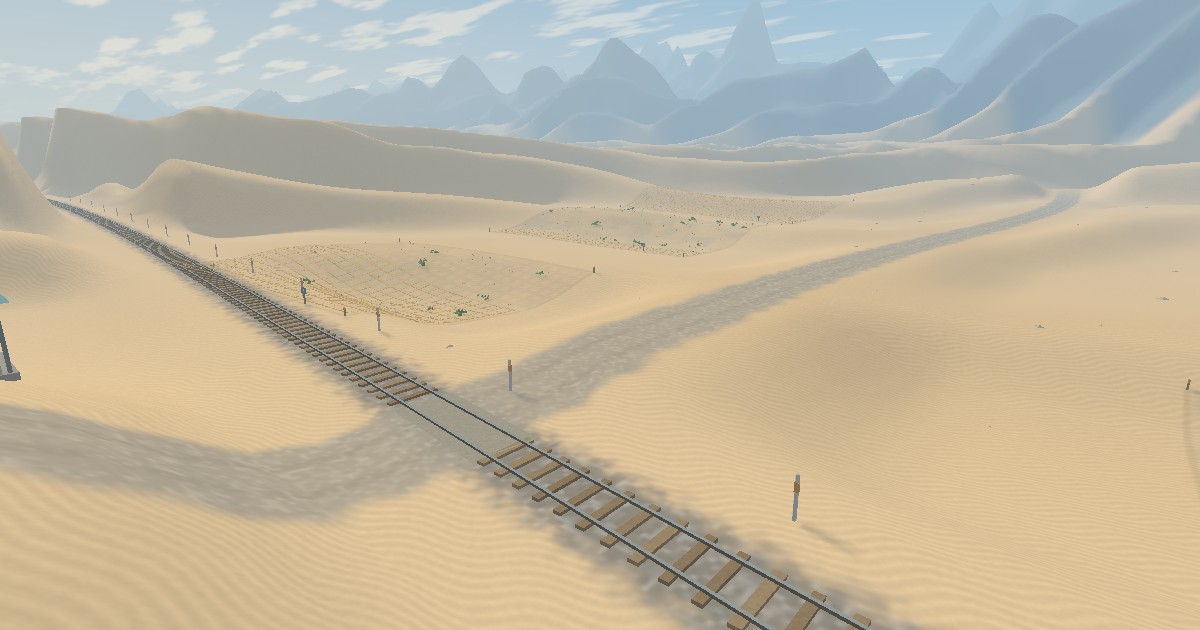
Bell River has released Sand Frontier: Tengger, a free 3D desert restoration game for the browser. Players manage five restoration plots beside a fictional railway on the edge of China’s Tengger Desert. The challenge is to keep windblown sand away from the line over eight simulated years, establish native vegetation and finish with water in reserve. The English and Simplified Chinese editions each run in a single HTML file.
Protect a railway across eight years
From ground level, players can walk between a rail embankment, a gravel terrace, a sheltered hollow, an exposed slope and a dune crest. The overhead view makes it easier to compare the plots. An unmanaged sixth dune serves as a control, so players can observe how windblown sand and vegetation change without treatment.
Straw checkerboards reduce sand transport as soon as they are installed. They wear down during the simulation and can be renewed. Native grasses and shrubs need time to establish, and planting too densely draws down soil moisture. Players can spend their limited water on targeted irrigation or restrict foot traffic to give biological soil crust time to develop. The forecast and field journal track changes in weather, vegetation, rail protection and the water reserve.
Two scenarios use the same landscape. A typical weather cycle alternates wetter and drier years. The prolonged drought brings lower rainfall and less water for replenishment. Both scenarios judge rail protection across the final two years, vegetation cover across the final four, and the water left at the end. An exposed dune crest and a moisture-retaining hollow can call for different decisions in the same year.
How straw checkerboards work in the Tengger Desert
The game draws on research at Shapotou, on the southeastern edge of the Tengger Desert in Ningxia. There, teams developed sand-control measures to protect the Baotou–Lanzhou railway. Field experiments and modeling found that partly burying straw in a grid roughens the surface, slows wind close to the ground and reduces sand transport. The studied barriers needed periodic replacement.
Decades of observations at Shapotou also showed why water and time matter. The vegetation shifted as moisture changed at different depths. At the studied sites, a shift toward a more grass-dominated community with well-developed biological soil crust took roughly four decades. The game uses shorter timescales, a soil moisture index and a fictional water budget so players can compare strategies in one session.
Play in Chrome or save the game for offline use
Open the game in Chrome with WebGPU available and start a scenario. On a keyboard, use WASD to move, hold Shift to run and press 1–6 to jump between plots. Drag across the scene to look around. Touch devices with WebGPU also have on-screen movement controls. The in-game field guide explains the targets and links to the research.
The landscape, vegetation and optional wind audio are generated locally. To play offline, download the HTML file and open it directly in Chrome. The game needs no external scripts, images or audio files.
Why make a single-file simulation
A single HTML file lets classrooms and curious players try the same scenario with or without a network connection. The simulation makes the trade-offs between sand movement, vegetation and water visible one year at a time.
- Straw checkerboards slow windblown sand immediately. Sustaining native plants through dry years takes patience and careful use of water.
- The unmanaged control dune gives players a point of comparison for the five working plots.
- Both language editions generate the landscape locally and run offline from a single HTML file.
The railway and plots are fictional. The game compresses timescales and uses a simplified water balance.
Sources & editorial note
- Chinese Academy of Sciences history
- Qiu et al., field experiments
- Li et al., soil-water observations
- Chen et al., 49-year vegetation analysis
This is a Bell River product announcement. The linked studies and institutional history document the fieldwork that informed the game.